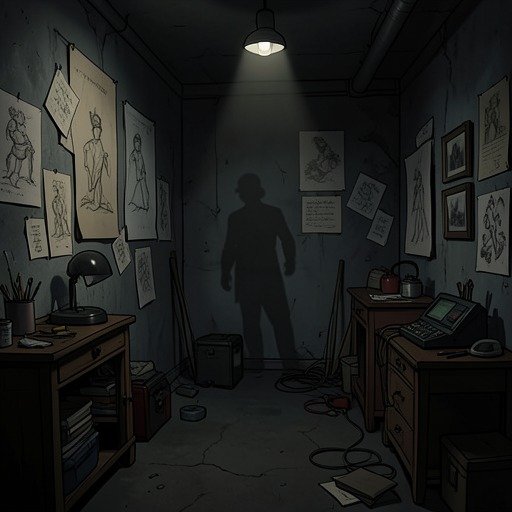
The Narrator Discovers Paintings in the Farmhouse Basement
I'm Thinking of Ending ThingsThe Narrator Discovers Paintings in the Farmhouse Basement is a discovery scene in which a concealed part of Jake's parents' farmhouse turns a family visit into an encounter with a disturbing visual record. Following a faint mechanical sound below the kitchen, The Narrator finds a painting of the basement and a series of drawings that repeatedly place an enigmatic adult figure and a child in the room. The images do not explain who made them or what they represent, but their variations, together with an argument overheard above, make the basement feel less like unused storage than a space where concealed histories have accumulated.
The Descent into a Hidden Room
While Jake is in the kitchen with his parents, The Narrator chooses not to hurry back to him. In the hall she notices an open door and a narrow, steep staircase descending toward the basement. The door creaks at the slightest movement; its hinges need grease, and a small, frayed carpet lies at the landing. At first she can see little in the darkness. She pulls a white string to switch on a single bulb and hears the source of a dull, repetitive grinding more clearly. Curiosity keeps her moving: Jake had said that his parents did not use the basement, and she wonders what could be making the noise.
The stairs are uneven and have no banister. A floorboard trapdoor, held open by a metal clip, would conceal them when shut. Scratches cover it, shallow but frantic-looking. The Narrator descends with one hand on the wall, onto a large concrete slab set over gravel. The low-beamed room is cramped, with shelves of damp, stained cardboard boxes and, behind the stairs, a furnace, hot-water tank, electrical panel, and an old, rusty piece of equipment whose purpose she cannot identify. The walls are dirt and bedrock. There is no recreational furniture, only a dank smell and the feeling of a hole beneath the house. The room's contents make the claim that there is nothing there plainly untrue, even before the artwork comes into view.
The Fan, Painting, and Drawings
At the far end, beyond the water tank, The Narrator finds a small white oscillating fan on a shelf. Its back-and-forth creak is the sound that drew her downstairs. The fan is running in winter, when the basement is already cold. Near the furnace stands a painting on an easel, which suggests a possible reason for the moving air: perhaps it is drying paint. Yet The Narrator sees no brushes, other painting supplies, or chair. She considers Jake's mother as a possible painter, but the low ceiling would force someone taller than The Narrator to bend. Neither the maker nor the purpose of the arrangement is established.
The painting depicts the basement itself, including the stairs, concrete slab, and shelves, but omits the furnace. In its place stands a long-haired person, perhaps a woman or a man, bent slightly beneath the low ceiling. The figure has long arms and fingernails that look almost like claws; the strokes are wild and heavy, while some details are sharply specific. A much smaller person, possibly a child, appears in a bottom corner. The image makes the familiar room strange by reproducing its actual layout and then replacing a piece of household equipment with a humanlike presence. Its ambiguity is central: The Narrator can describe the body but cannot settle its identity.
Beside the painting, a small, dirty bookcase holds old papers and drawings. The pages all depict the basement, but the figure in place of the furnace changes from one image to another. Some versions have short hair, others long; one has horns. Bodies vary, including figures with breasts, penises, or both. Across these changing forms, the long nails and a similar knowing, paralyzed expression recur. The child also persists, usually in a corner, but sometimes on the ground looking up at the larger figure. In one drawing the child is inside a woman's stomach; in another, the woman has two heads, one of them the child's. These are not simply repeated copies of the painting: each drawing reworks the relationship between the two figures while retaining the room as its setting. The pictures establish a pattern without supplying a key to it.
What The Narrator Hears Above
The Narrator recalls Jake's explanation, during the drive, that understanding depends on both rational thought and symbols. He had described allegory and metaphor as ways people discern significance alongside experience, and had emphasized the part of understanding that is closer to feeling or spirit. Looking again at the painting, The Narrator connects his account to the visual scene. That connection does not solve the pictures; it makes them part of a question about how meaning is made when literal explanation is unavailable.
Footsteps upstairs lead The Narrator to listen more closely. She hears Jake's parents talking in the kitchen, and their conversation becomes heated. To hear better, she places a rusty paint can beneath a vent and stands on it. The fragments she makes out concern someone who left a laboratory, should not have taken that path, and needs a job he can keep. One voice says that he had spent all that time getting there only to quit, and expresses worry. The Narrator wonders whether they mean Jake: she believes he is still working at the lab, so the overheard account conflicts with what she thinks she knows. The conversation does not resolve that contradiction, and it does not establish who created the pictures. Instead, it adds a second concealed narrative to the scene, one spoken indirectly through the floorboards.
Interruption and the Scene's Significance
The paint can tips, and The Narrator crashes against the wall. The voices stop. She freezes, looks toward the stairs, and hears no one; the room is quiet, and she is alone. Her effort to move closer to the conversation has turned into the risk of being discovered, and the abrupt silence leaves her without the rest of what the parents were saying. As she climbs back, she notices the trapdoor's lock and latch. The latch is fixed to the wall beside the stairs, while the lock is on the underside of the trapdoor: it can be locked only from below. The detail sharpens the basement's sense of enclosure, even though The Narrator does not report being locked in.
The scene builds its unease through physical access and incomplete knowledge. The Narrator enters because a sound invites explanation; each answer—a fan, a painting, a stack of drawings—opens onto another uncertainty. A recognizable domestic room becomes the setting for images whose repeated figures suggest an ongoing preoccupation, but the text withholds their author and meaning. Above, family conversation offers information about a possible rupture in Jake's working life, yet only in fragments and in conflict with The Narrator's understanding. The basement discovery therefore joins two forms of evidence that cannot be fully reconciled: images preserved beneath the house and speech overheard from its kitchen. Both make the farmhouse's apparent ordinary life feel less transparent, while leaving The Narrator, and the reader, to interpret what has been revealed.